
Beach’s and Joyce’s collaboration lasted more than a decade. Most of it occurred after the publication of Ulysses. While she took care of his relentless demands nearly every day, she also published two more Joyce-related books.
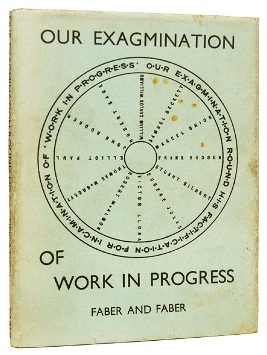
Keeping Ulysses in print was a central task that provided both author and publisher with an income. Beach agreed to publish two more Joyce-related books. The first was Joyce’s second volume of poetry, Pomes Penyeach (1927), for which she also negotiated settings to music. The other was an essay collection self-ironically titled Our Exagmination Round His Factification for Incamination of Work in Progress (1929) – a book that Joyce himself had instigated to promote his next big project, Work in Progress (released in 1939 as Finnegans Wake).
Beach’s Various Roles
For Work in Progress Beach acted as Joyce’s unofficial literary agent. She arranged for the publications of various portions, with profitable editions by fine arts presses among them, to be sold at her bookshop. These revenues helped mitigate Joyce’s chronic financial troubles. Likewise, Beach took care of issues concerning his earlier works, such as new editions and translations.
Beach also dealt with the negotiations for translations of Ulysses and managed Joyce’s other affairs: finding a flat for his family, answering his mail, and so on.
Fighting the Pirates
Pirated editions claimed even more of her time and money: an illegal Japanese translation, an American edition of Joyce’s poems – and particularly Samuel Roth’s unauthorized American reprint of Ulysses in 1926. Beach set up a letter of protest and collected signatures from 167 international writers and thinkers, among them Virginia Woolf, Hugo von Hoffmansthal, Italo Svevo and Albert Einstein. The open letter urged readers to boycott Roth for his “appropriation and mutilation” of the novel.
Joyce expected Beach to share the lawyers’ fees, arguing that she owned the Ulysses copyrights. He even suggested that Beach transplant her shop to the U.S., in order to fight piracy more effectively – one of the rare demands that she rejected.
Money Matters
Since Joyce refused to open a bank account, Beach acted as his banker. Whenever he needed money,she would send him a banker’s draft. Joyce often failed to return these payments to her. In addition, he would increasingly ask Beach for advances on projected royalties.
Throughout, Joyce deemed it unnecessary to pay Beach for her services. To him, her profits from Ulysses seemed sufficient as compensation.
Text by Ursula Zeller