
America marks both the beginning and the end of the professional and personal relationship between Joyce and Beach.
The ban on Ulysses had turned Beach into a publisher, and her bookshop profited from U.S. censorship. Hundreds of copies of Ulysses were smuggled into the country during the ten years of her Paris editions. However, the enormous potential of the American market remained largely untapped.
An Author’s Machinations
In 1930, Joyce suddenly insisted on a contract for Ulysses, having always declined Beach’s earlier suggestions. His “Memorandum of Agreement” granted her exclusive world rights on the novel. If “deemed advisable by author and publisher”, Beach’s rights would be sold to another publisher “at a price set by herself”. Joyce thus left the duty to repay Beach to an entity who was not a party to the contract.
Behind this move was Joyce’s chronic shortage of money: Facing costly lawyers’ fees in the Samuel Roth piracy case, he hoped to pass some of the costs on to Beach, once her rights ownership was legally confirmed.
At the same time, however, he aimed for the U.S. market and began looking for an American publisher – behind her back.
When eventually approached by two U.S. publishers, Beach demanded a compensation of $ 25,000 – a sum intended both to compensate her for future losses and to serve as belated recognition of her investments into Joyce’s novel. However, the two publishers rejected the offer as far too costly.
Bullied into Relinquishing Her Rights
In late 1931, Joyce’s friend, the Irish author Padraic Colum, whom he often sent on difficult missions, visited Beach several times, falsely suggesting that she had no rights in the novel. Matters eventually came to a head when Colum shouted at her that she was standing in Joyce’s way. Beach immediately called Joyce and relinquished all rights in Ulysses.
In March 1932, Joyce signed a contract with Random House. It would take almost another two years for the American ban to be lifted and for Ulysses to appear in the U.S. In the first two months of its publication, it sold more copies than Beach did with her eleven editions in ten years.
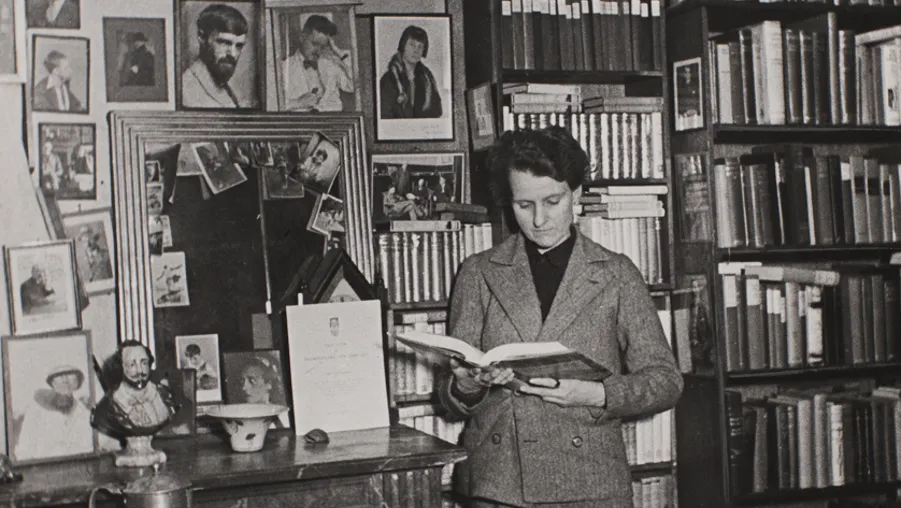
While Beach and Joyce never completely lost touch, his friend Paul Léon increasingly replaced her as Joyce’s administrator and adviser.
Text by Ursula Zeller