
As the publisher of Ulysses, Beach gained fame and also made some profits. She proved to be a publicity talent – but since her generosity led her to disregard most commercial maxims, her means remained limited.
Beach’s deluxe edition required a special financing system. To fund the massive production costs and to reduce her financial risks, prospective readers had to subscribe in advance and thus became investors in Beach’s venture. The book’s high price, with Joyce’s unprecedented royalties, also turned the readers into quasi-patrons supporting the artist.
A Most Generous Arrangement
Beach granted Joyce 66% royalties for the deluxe first edition (50% were standard). For the following eleven “ordinary” editions, she still agreed to a generous 25% instead of the usual 15%.
The Paris edition of Ulysses soon became a collector’s item. Booksellers would buy several copies, hold them back and eventually sell at twice or even three times the original price.
As Joyce wrote to his aunt Josephine, within six months his novel was sold at £40 in London and would soon be worth £100 (instead of Beach’s £7 price).
Succès de Scandale
Beach took a great interest in modern publicity and soon displayed a talent for it. As she wrote to her sister Holly: “Ulysses is going to make my place famous!”, and to her mother: “It means thousands of dollars of publicity for me.” Beach realized that the newspaper coverage of the Ulysses trial in New York had generated publicity for her edition even before it was published. She consequently used that scandal in her promotional material by emphasizing that suppressed passages would be made available for the first time. In the same vein, when the book was published, she would turn scathing reviews into advertising capital and reprint them just as often as critical praise.
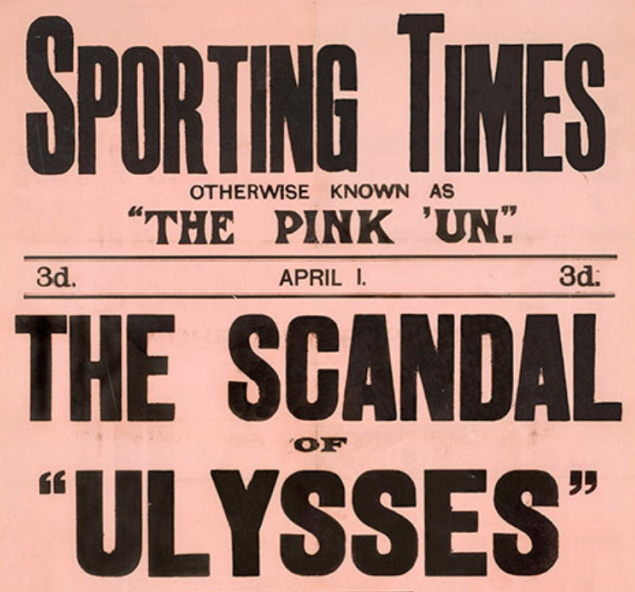
She also prominently displayed a poster by the London weekly Sporting Times in her bookstore, with the headline announcing: “The Scandal of Ulysses”. Clearly, for Beach there was no such thing as “bad publicity”.
Text by Ursula Zeller