
Beach remained in Paris throughout the German occupation and lived there until her death.
While the Nazis censored many of Beach’s favourite authors, she could keep her bookshop open, enjoying some protection from the American embassy. Nevertheless, Beach’s and Monnier’s antifascist activities made them suspicious to the Germans. They repeatedly hid members of the Résistance and helped Jewish friends like Arthur Koestler or Walter Benjamin escape from occupied France. Beach also refused to dismiss her Jewish assistant and friend, Françoise Bernheim.
The End of Shakespeare and Company
The end came in 1941, when Beach refused to sell a Nazi officer her last copy of Finnegans Wake.
“We admire Joyce very much in Germany”, he insisted, threatening to return and confiscate her stocks. Thesame day, Beach removed all the books to a flat above her shop. It never reopened in her lifetime.
When the U.S. entered the war, Beach became an enemy alien and was interned in the Vittel camp in the Vosges Mountains, together with other citizens of allied states, as well as European Jews, who were later deported to Auschwitz. Thanks to a friend’s intervention Beach was released after six months.
Hemingway Liberating Rue de l’Odéon
Returning to France as a war correspondent, Hemingway later joined the U.S. troops who liberated Paris. As Beach remembers in her memoirs:
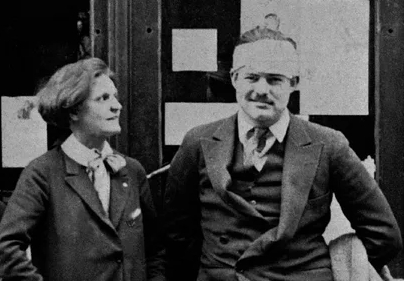
As Beach remembers in her memoirs: “I heard a deep voice calling: ‘Sylvia!’ And everybody in the street took up the cry of ‘Sylvia!’ ‘It’s Hemingway! It’s Hemingway!’, cried Adrienne. I flew downstairs: we met in a crash. He picked me up and swung me around and kissed me while people on the streets and in the windows cheered.”
Text von Ursula Zeller